Which Payment Workflow is Right for Your Freight Operations?
Not every lane carries the same financial risk. A high-value, first-time cross-border consignment demands a fundamentally different settlement approach than a recurring domestic haul with a vetted carrier. CargoPay delivers three structured payment workflows: each engineered to match the risk profile, route complexity, and counterparty trust level of your real-world freight operations.
Three Workflows. Three Risk Profiles.
CargoPay's payment architecture mirrors the operational realities of European road freight. Each workflow: Immediate, Authorisation, and Deposit & Balance: addresses a distinct risk profile, from spot-market transactions with unverified counterparties to recurring lane commitments with established logistics partners.
Your selection should be guided by counterparty history, consignment value, route risk exposure, and the operational complexity of the haul. The right workflow protects your margin while keeping freight moving.
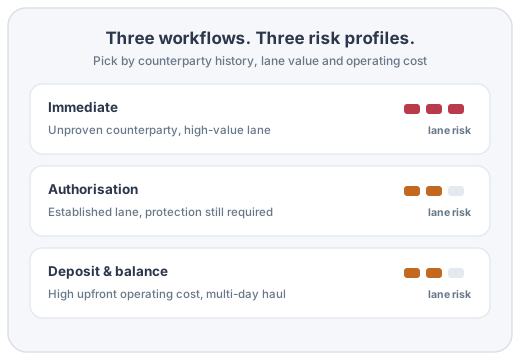
Compare the Three Workflows
Each workflow is engineered around a specific risk scenario. Select the one that aligns with your operational exposure.
Immediate Payment
Full settlement completed before dispatch. Funds are transferred and cleared prior to loading: eliminating counterparty risk entirely.
Best For
- First-time or unverified counterparties
- High-value consignments (>€10,000)
- High-risk corridors or volatile markets
- Cross-border counterparties with limited credit history
Authorisation Payment
Funds authorised and ring-fenced at dispatch; captured only upon proof of delivery confirmation. Protects both shipper and carrier.
Best For
- Established trading relationships with proven on-time performance
- Mid-value freight lanes with predictable transit times
- Controlled trust scenarios with verified carrier credentials
- High-frequency lane partners with consistent POD records
Deposit & Balance
An upfront deposit secures capacity; the remaining balance settles at agreed milestones or upon final delivery. Aligns cash flow with operational progress.
Best For
- Long-haul or multi-leg intermodal shipments
- Operations with significant upfront fuel, toll, or customs costs
- New relationships requiring graduated trust milestones
- Working capital optimisation for fleet operators
How to Choose the Right Workflow
Apply these four criteria to select the optimal payment structure for every consignment.
Counterparty Relationship
New trading partners warrant conservative payment structures. Established carriers with proven lane performance and on-time delivery records may qualify for authorisation-based workflows.
Consignment Value
Higher-value loads demand stronger payment security. A €50,000 full truckload warrants significantly more protection than a routine €2,000 LTL shipment on a familiar lane.
Risk Exposure
Factor in counterparty credit risk, market volatility on the route, and any known fraud patterns. Cross-border lanes into emerging markets typically carry elevated risk profiles.
Operational Complexity
Multi-leg, long-distance, or cross-dock operations may require staged payment structures to align carrier cash flow with fuel, toll, and handling costs at each transit node.
"The right payment workflow is the one that aligns your financial exposure with the operational reality of every lane, every load, and every partner."